Every third Sunday in July, Venice pauses to remember. Thousands of illuminated boats glide across the St. Mark’s Basin, fireworks light up the night sky above Giudecca, and a temporary bridge of boats spans the canal, allowing Venetians to walk to the Redentore, the church of the Most Holy Redeemer that gives the feast its name. It is a joyful celebration, almost pagan in its exuberance—yet its origins lie in one of the darkest chapters of the city’s history.
A Vow Born of Sorrow
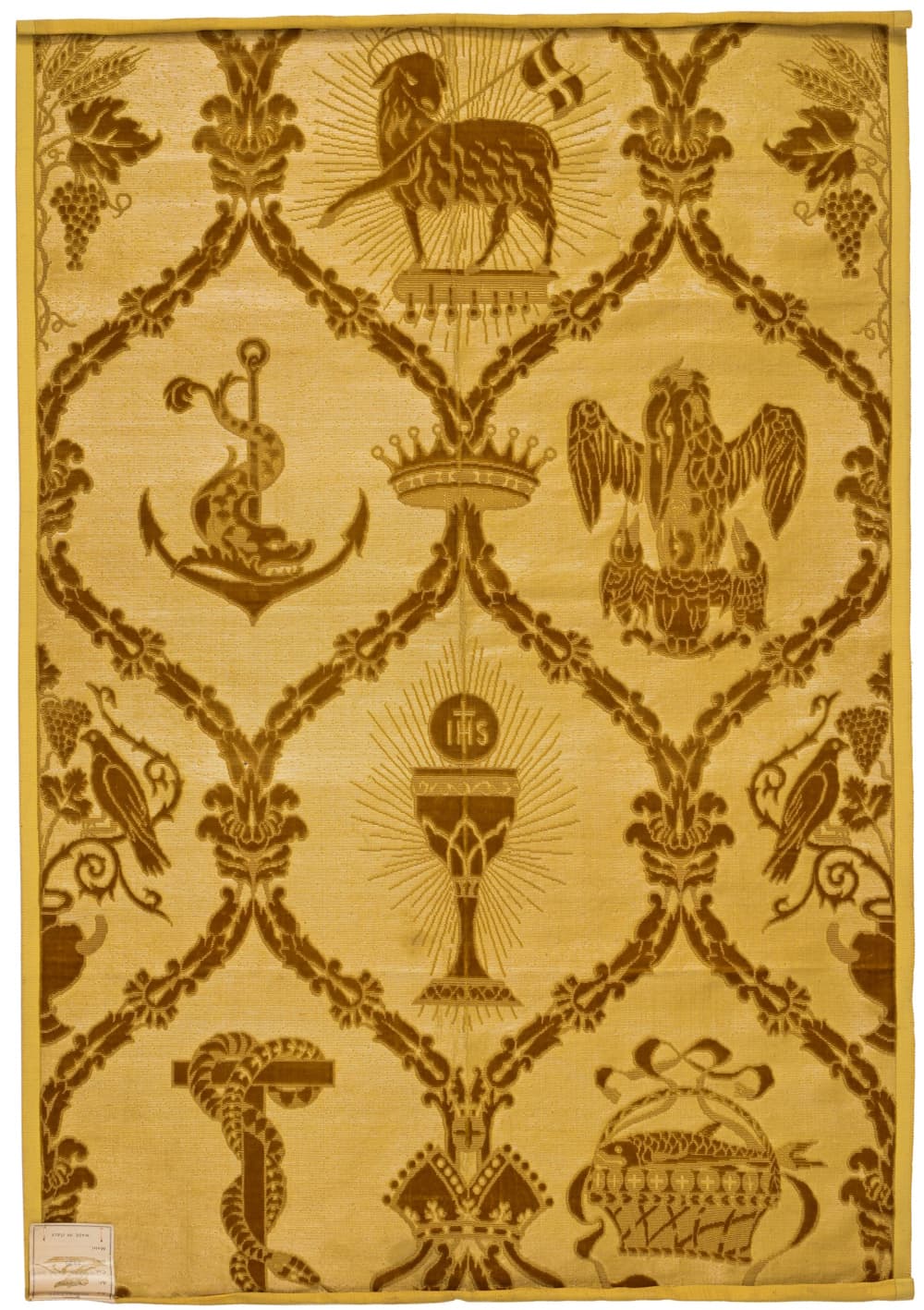
Silk soprarizzo velvet featuring a Christological iconographic program—Agnus Dei, the Pelican in Her Piety, and the IHS monogram within a chalice—representative of Venetian liturgical textiles from the 17th and 18th centuries. Luigi Bevilacqua Historical Archive, Venice. [Archive No. 0025]
Between 1575 and 1577, the plague claimed nearly one-third of Venice’s population: more than fifty thousand lives, according to contemporary chronicles. In response, the Senate of the Republic made a solemn vow: if the city were freed from the epidemic, a church dedicated to Christ the Redeemer would be built, and each year the Doge himself would cross the canal to offer thanks.
The plague eventually subsided. Andrea Palladio was commissioned to design the votive church on the island of Giudecca, and in 1577 the celebration we still observe today was born: a ritual of remembrance and renewal, where mourning is transformed into light, and the fragility of life is answered with a shared act of beauty.
When Beauty Becomes an Act of Gratitude
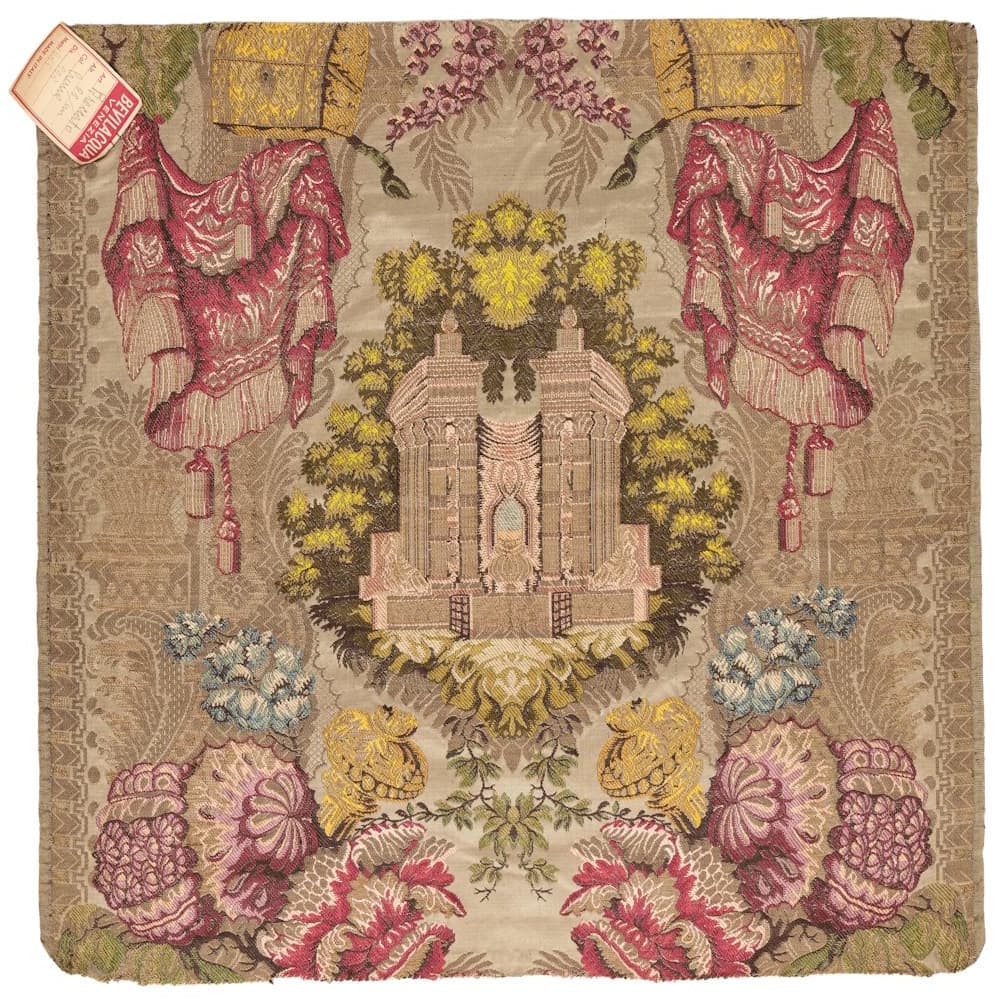
Brocade depicting a classical temple flanked by draped allegorical figures amid an abundance of flowers and garlands. Luigi Bevilacqua Historical Archive, Venice. [Archive No. 0051]
It was during these decades of crisis and recovery that Venetian textile artistry established itself as one of the Serenissima’s most celebrated crafts. As the city sought answers to suffering through faith, art, and architectural splendor, its velvet and damask workshops continued to weave—quite literally—a vision of beauty that was not an expression of vanity, but of resilience. To produce exquisite textiles in an age marked by fear and loss was to affirm that life, care, and the patient rhythm of skilled craftsmanship still held meaning.
Bevilacqua was born from this very tradition and proudly carries forward its deepest legacy: not merely technical mastery, but the conviction that beauty—whether in soprarizzo velvet, sumptuous brocade, or gold woven into the fabric itself—is also a way of engaging with the world, of honoring it, and of giving thanks. Just as Venice responded to the plague of 1577 by raising a temple and illuminating the sky with fireworks, Venetian textile craftsmanship has continued to answer the passage of time by weaving enduring beauty, thread by thread, on its looms.
Textiles in the Service of Faith
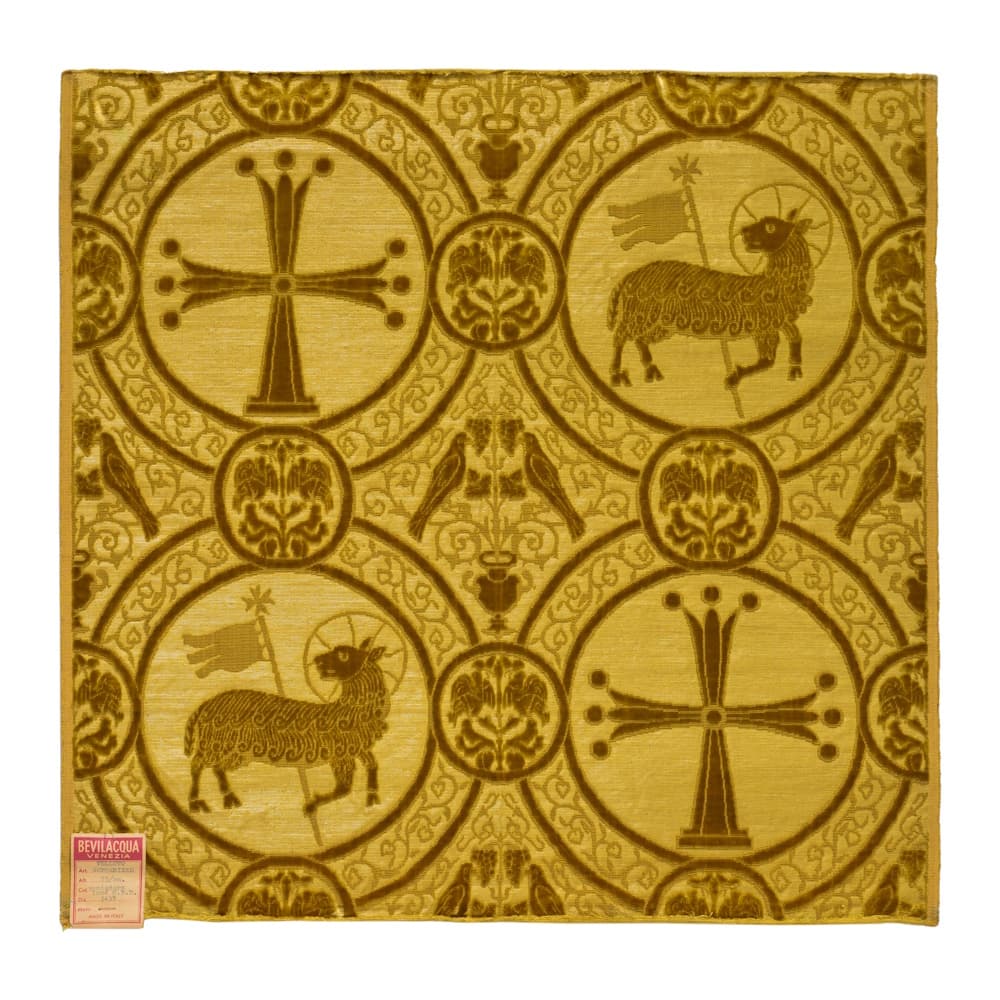
Silk soprarizzo velvet featuring the Agnus Dei, crosses, and liturgical motifs on a gold ground. Luigi Bevilacqua Historical Archive, Venice. [Archive No. 0005]
There is an even more direct and tangible connection between the Festa del Redentore—as Venetians call the feast—and the world of fine textiles. Palladio’s church—restrained on the outside, luminous and majestic within—has for centuries housed sacred vestments, liturgical hangings, and altar frontals: works that required, and still require, the hands and looms of Venice’s finest weaving workshops.
For centuries, the churches, confraternities, and religious institutions of the Serenissima entrusted Venetian velvets and brocades to adorn altars, pulpits, and sacred celebrations. These fabrics were never meant simply to be beautiful—they were created to convey meaning. The richness of the weave, the depth of color, and the light captured and reflected by sculpted velvet were—and remain—a way of honoring the sacred through the beauty of material itself.
That vocation has never been interrupted. Today, Bevilacqua continues to work alongside those restoring churches, historic palaces, and places of worship, recreating on its eighteenth-century hand looms the very same patterns, techniques, and meticulous craftsmanship that animated Venetian weaving workshops during the years of the plague and its aftermath. It is a thread—quite literally—that has never been broken: from the Doge’s vow and the Redentore church to the velvets that still adorn altars and ceremonial interiors around the world.
A Thread Connecting Venice’s Two Votive Churches
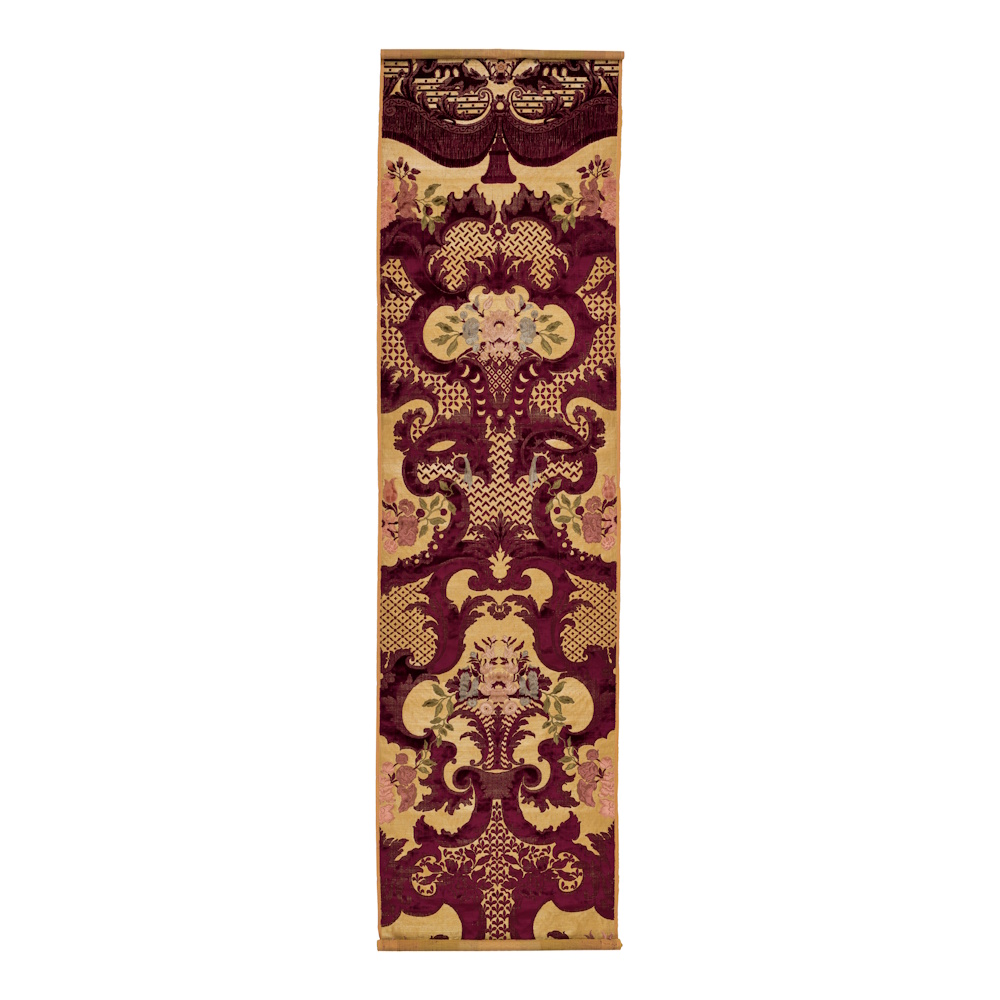
Colonne soprarizzo velvet: a gold ground enriched with deep crimson tones, tulips, daffodils, roses, peonies, and genuine gold threads. Featuring a four-meter repeat, it was woven on Jacquard looms using 8,000 punched cards. To this day, it adorns the columns of the Basilica della Salute during the Feast of Our Lady of Health on November 21. Luigi Bevilacqua Historical Archive, Venice. [Archive No. 0046]
The Redentore and the Salute are sister churches in Venice’s history: both were built as votive churches, each born from a solemn vow made by the Senate of the Serenissima at the end of a devastating plague. The first was built in 1577 following the epidemic of 1575–77; the second in 1631 after the plague of 1630–31. Two epidemics, two promises, two churches that continue to inspire the devotion of Venetians today.
Bevilacqua is part of both stories. Between the 1950s and 1960s, commissioned by Cardinal Angelo Roncalli—then Patriarch of Venice and soon to become Pope John XXIII—our Tessitura created the Colonne soprarizzo velvet to cover the columns of the high altar and the eight side chapels of the Basilica della Salute. A photograph taken in 1957 captures Cardinal Roncalli visiting the weaving mill, examining the velvet alongside Cesare and Giulio Bevilacqua and the sixty women weavers employed there at the time.
Colonne is one of the most technically sophisticated textiles ever produced by Bevilacqua: a four-meter design repeat woven on Jacquard looms using 8,000 punched cards, featuring a golden-yellow ground, deep crimson tones, tulips, daffodils, roses, peonies, and genuine gold threads. It is a woven garden, faithfully recreating the historic fabric that had adorned those very columns for centuries.
To this day, every November 21, that velvet returns to its rightful place. Among the artisans who wove Colonne velvet was Mariella Bearzi, who worked at Bevilacqua from the age of twelve until she retired at sixty-seven:
“I still visit the Basilica every year during the feast days. I’m certain that one of those columns bears a piece of velvet woven by my own hands.”
A thread—quite literally—that has never been broken.
→ Discover the full story of the Colonne velvet and the Basilica della Salute: https://www.luigi-bevilacqua.com/velluto-colonne-salute-venezia/
The Splendor of the Serenissima
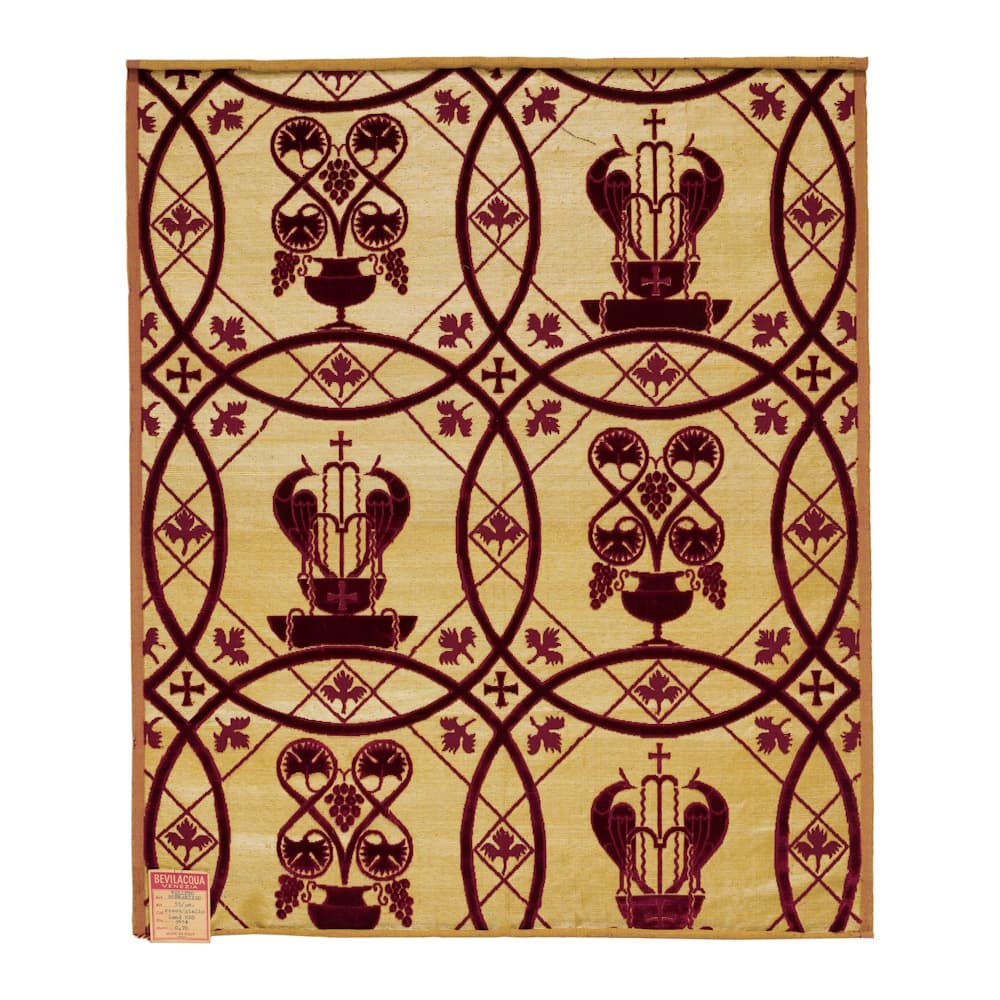
Silk soprarizzo velvet featuring the papal tiara, Eucharistic chalice, dove with an olive branch, and vine scrolls—a complete theological program woven in burgundy silk on a gold ground. Luigi Bevilacqua Historical Archive, Venice. [Archive No. 0084]
A Celebration, A Living Legacy
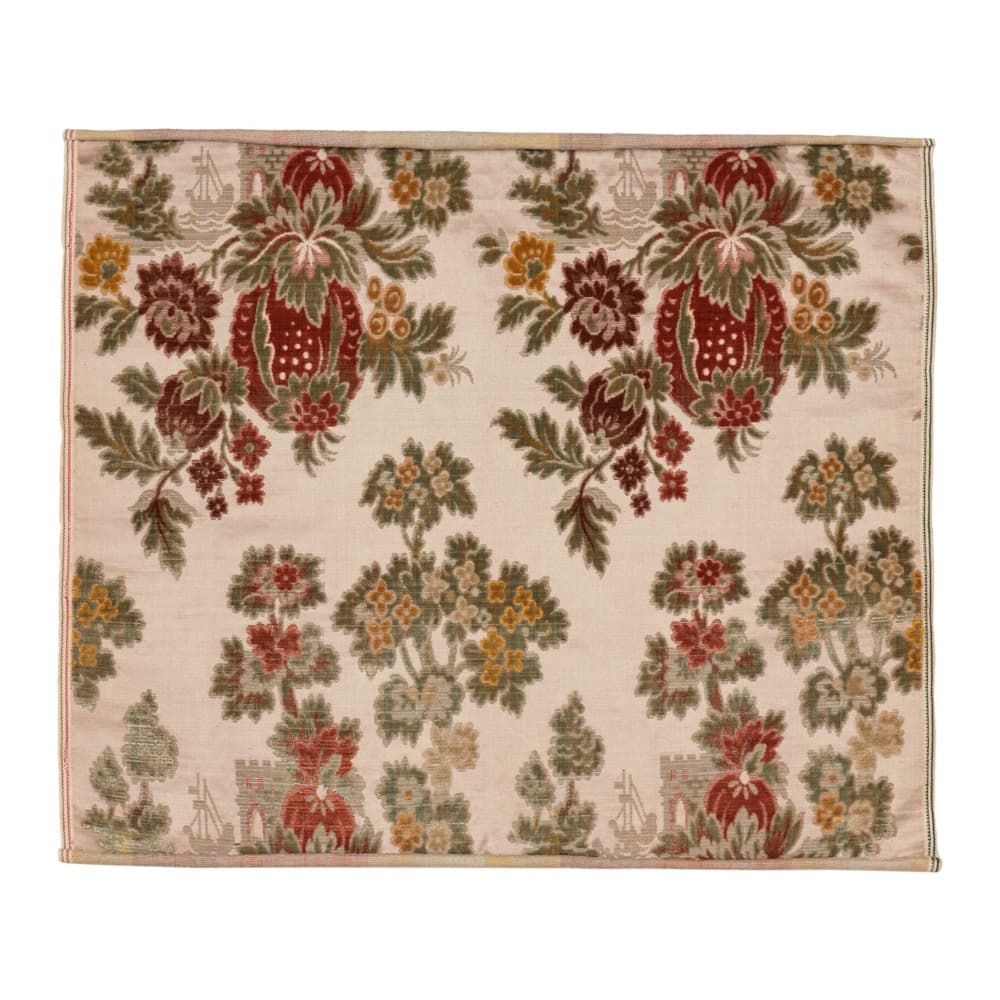
Velvet depicting sailing vessels on the Venetian lagoon, pomegranates, and floral motifs. Luigi Bevilacqua Historical Archive, Venice. [Archive No. 0052]
The Festa del Redentore reminds us that Venice has always answered suffering with beauty, and fear with light. It is a lesson that Bevilacqua continues to embody every day in its historic workshop: velvet and brocade are not merely precious materials, but living expressions of a city that, in its darkest moments, chose never to abandon beauty.
This year, as the bridge of boats once again connects the shores of Giudecca, we are reminded that the same Venice that raised a church in gratitude is the Venice that has never stopped weaving.
Archival textile photography courtesy of Tessitura Luigi Bevilacqua, Venice. Photos by Filippo Guerra – Studio Otium.