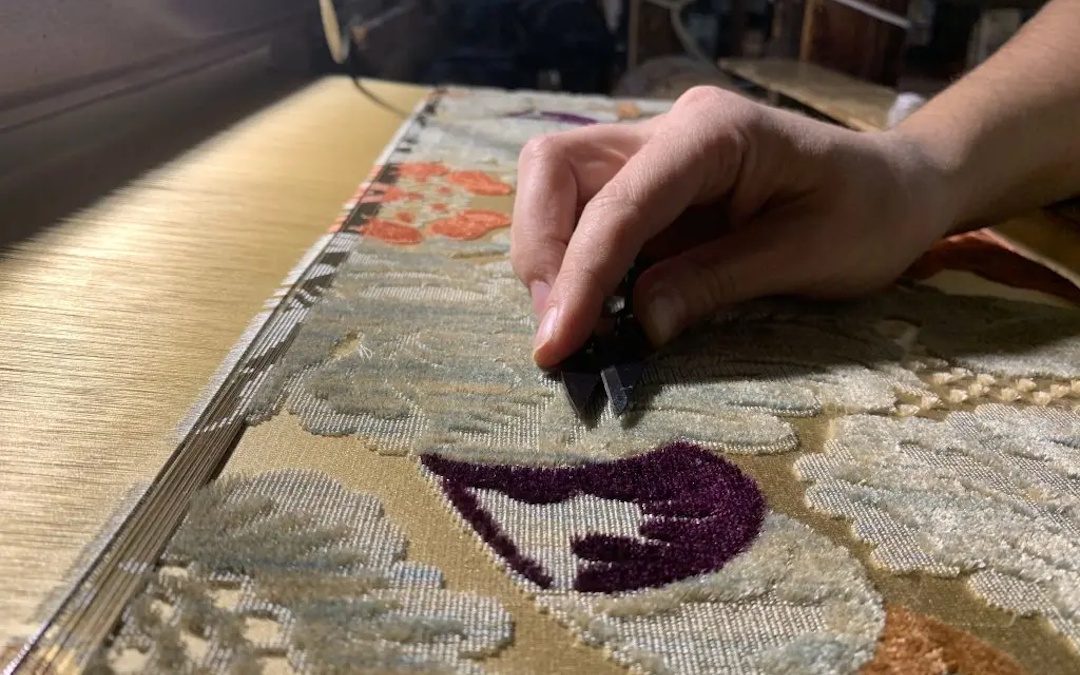
In the heart of Venice, among silent calli and canals that reflect light like liquid silk, opens the atelier of Tessitura Luigi Bevilacqua, at 1320 Santa Croce. Here, four weavers intertwine threads and patterns with grace and precision, transforming daily labor into material poetry. Silvia, Ilaria, Carlotta, and Giulia guard an ancient knowledge, embodied in the 18 original 18th-century looms, rescued in 1875 from the Silk School of the Serenissima.
These instruments, patiently restored and cared for, become extensions of their hands: with delicacy and control, they guide every thread, creating velvets that breathe the history and craftsmanship of generations of artisans. Three of them lead us through their world, sharing experiences, secrets, and curiosities of a craft where every inch of fabric is unique and precious.
Handweaving Velvets on Old Looms: Challenges and Value
Every velvet is born from a slow, delicate ritual. Giulia tells us that simply setting up a hand-weaving loom can take one to two months, up to six for the most complex creations. But the true magic demands even more time: behind every inch of fine fabric is the hand of a human being, which some days is vigorous, weaving up to 40 cm in eight hours, other days slows down, giving life to a different rhythm.
Precision is essential: the iron bars that shape the velvet pile must be carefully removed, and the special blade must cut with skill, a gesture that is both physical and poetic. The loom’s pedals, pressed with force, create a dialogue between the Jacquard machine’s punched cards, the warp, and the weft threads.
“None of these operations can be done lightly,” Giulia says. “We are not machines. The small imperfections that sometimes appear in the fabrics do not diminish their value; in fact, they make them unique, authentic, artisanal.”
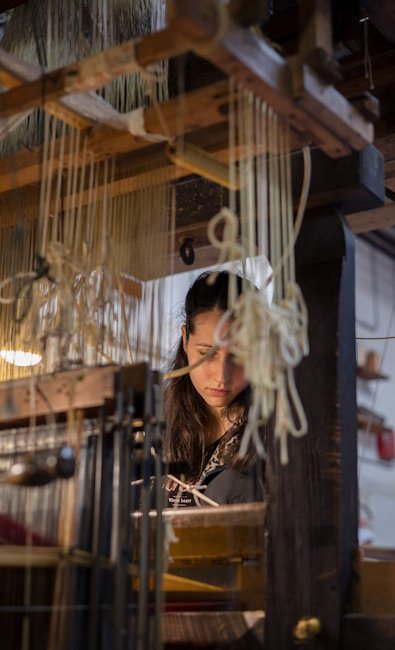
The weaver Giulia
Training in a Venetian Artisan Weaving Workshop
In the 19th century, becoming a weaver was a long and rigorous path: four to five years, starting at nine or ten years old. Today, though accelerated to two years, the journey retains the same spirit. Two fundamental phases guide the apprenticeship: observing an experienced weaver and mastering the loom perfectly before weaving a single velvet thread on one’s own.
Silvia recalls:
“I studied at the Art Institute of Textile, and it was there that I discovered Tessitura Bevilacqua. After finishing my studies, I sent my resume and was lucky: at that moment, they needed new weavers.”
But Ilaria emphasizes that the beginning is only a first step:
“When you arrive here, you need new training, both theoretical and practical. At school, there are no looms like these, so you learn gradually. Only by observing them for years do you understand the passing of threads, the knots, and how to intervene when something breaks.”
The most experienced weavers pass on their knowledge to the next generation, perpetuating an ancient cycle of mastery. Silvia and her colleagues learned from artisans now retired and will do the same with those who follow in their footsteps.
Daily experience also teaches the importance of humidity: when the air is too dry, the threads on the bobbins do not weave correctly. In summer, the weavers gently mist water under the cantra, the tool that holds the bobbins, to keep the velvet threads alive.
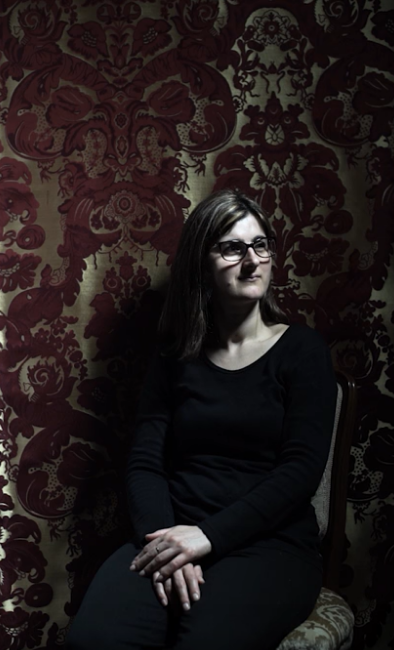
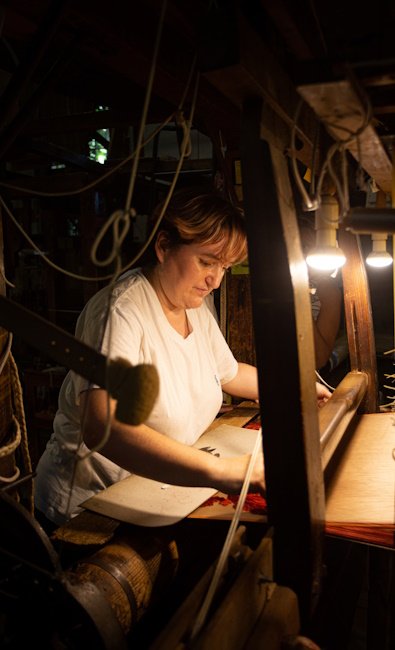
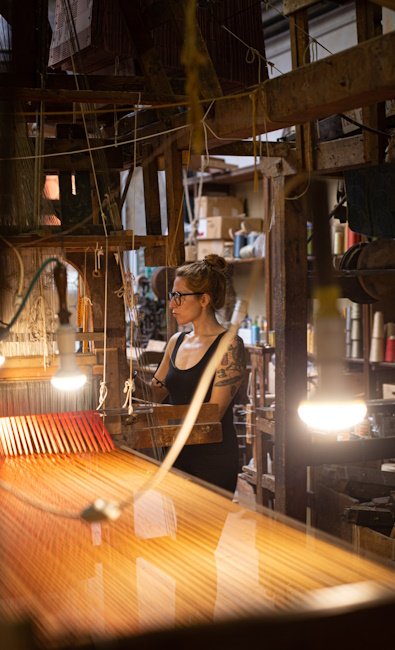
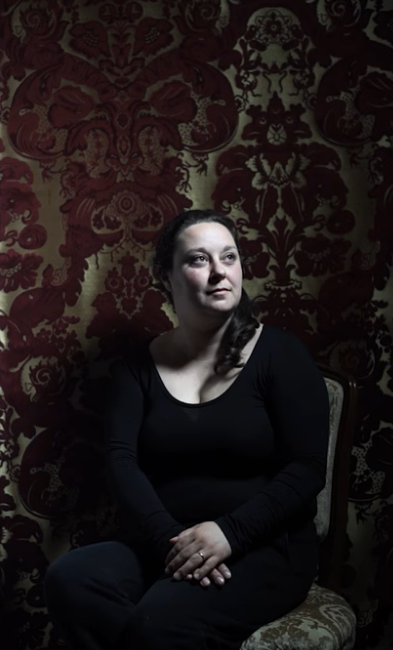
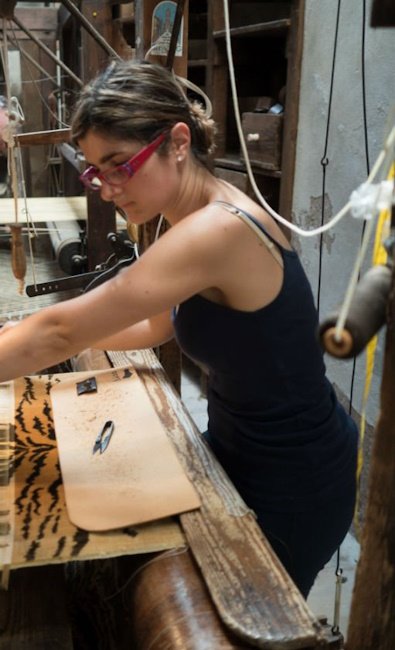
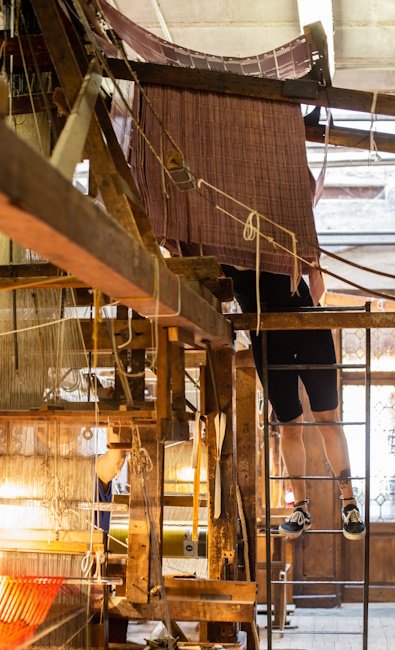
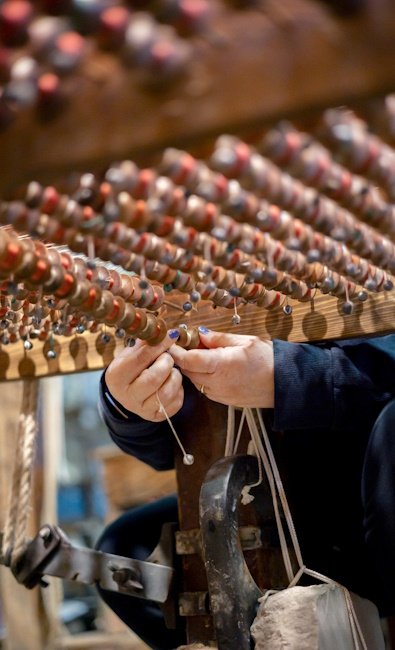
The weavers at Bevilacqua – Image Gallery
Working With a Manual Loom
The Bevilacqua manual looms are ancient, delicate, almost alive. They can break easily, and only the trained ear of a weaver can perceive the sign of a problem.
“Listening to the loom is essential,” Giulia explains. “There is no music in the room: the loom’s sound must be clear, recognizable. Any unusual noise requires immediate intervention, to avoid ruining the fabric.”
Weaving is a sensory art: sight alone is not enough. Every sound, every vibration tells the story of the threads and guides the expert hand to create masterpieces.
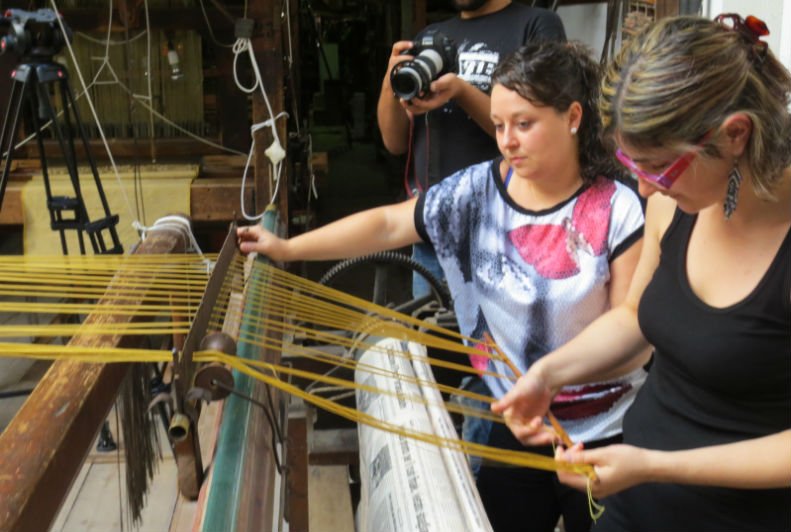
The weavers, Silvia and Ilaria
The Secret to Keeping a Tradition Alive
The work is complex, but every weaver knows they have created something unrepeatable.
“It’s a hard and demanding craft,” Silvia says, “but creating a unique piece with techniques and tools that almost no one else possesses is an indescribable satisfaction.”
The tradition, centuries old, lives on thanks to the passion and mastery of the artisans who safeguard it, passing it on to those who will come after them.
Listen to Silvia and Ilaria’s story in the video produced by Ampersand Video, in collaboration with the Venice Civic Museums and the Venice Academy of Fine Arts.
Photos by Camilla Glorioso and Marta Formentello